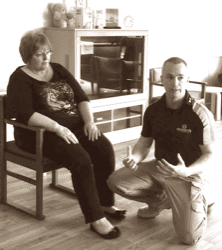
Restraint Training: Managing Distress and using force to clean a resident
Where an older person in care is soiled and needs the attention of care staff to get cleaned up, but resists verbally and physically (sometimes combatively) their efforts to do so, then we believe it is important that every step of the process to manage this scenario is managed in a clear, ordered and auditable way. As
on our blog, we believe that this kind of incident is reasonably frequent in some services and, as a foreseeable scenario which carries high risk, it should be properly risk assessed and is likely to need a formal, written procedure and protocol for the times when it is invoked.
Behaviours of concern are no longer isolated incidents in Irish schools. For many educators, exposure to verbal and physical aggression, supporting children in acute distress, and responding to crisis situations has become a recurring — and often under-acknowledged — part of the job. Responding to Behaviours of Concern and Crises in Irish Schools – Learning
Read More
Distressed Behaviours in Care Homes – what are the risks?We have met hundreds of care home staff in our training sessions, and this article aims to clarify some of the issues related to managing aggression and violence with older people, or vulnerable adults in care. We recently received gratitude from a client company that achieved a
Read More
Over time, decision-making becomes culture. 💡 If more team-members spoke up, more effectively and more often, how many disasters, scandals and failures could be averted? I was asked recently to help a team whose workplace ended up looking like a disaster-zone, because of the failure of the team – collectively – to make the right decision
Read More
Restraint Reduction OutcomesThe new trainer team for this service began rolling out their own programme (a four-day, full-spectrum course for their LD/MH setting) to their staff in October. By December, they had seen dramatic restraint reduction outcomes in key indicators such as time-in-restraint, floor-based-restraints and number-of-restraints for their high-frequency service users. “The amount of time we
Read More